This content is for informational purposes only and does not substitute professional medical advice. Always consult a physician for diagnosis and treatment.
In the high-performance world of modern leadership, health is the ultimate strategic asset. As we move through 2026, the paradigm of cardiovascular health management has shifted from reactive “crisis management” to proactive, precision monitoring. For the modern executive, whose schedule is often defined by a 50-plus hour work week and significant sedentary time, traditional episodic checkups are no longer sufficient. The “wait and see” approach of the past has been replaced by a data-driven, continuous monitoring model that prioritizes longevity and cognitive performance.
The challenge for the C-suite is not a lack of information, but a lack of time and the logistical friction of the traditional healthcare system. This is why at-home cholesterol testing has evolved from a convenience into a cornerstone of executive longevity protocols.
The Evolution of Cardiovascular Risk in 2026
Recent clinical data highlights that the typical executive spends upwards of seven hours a day seated—a factor that complicates cardiovascular disease prevention efforts. This “sedentary executive” lifestyle often masks silent physiological changes that can lead to long-term complications, even in those who appear fit.
Comparison: Traditional vs. Modern Executive Screening
| Feature | Traditional Clinical Visit | At-Home (Doctor2me) Model |
| Time Commitment | 3–4 hours (Travel + Waiting) | 15–20 minutes |
| Stress Factor | High (White coat hypertension) | Low (Comfort of home/office) |
| Privacy | Public waiting rooms | Total discretion |
| Risk of Infection | Exposure to seasonal illnesses | Zero clinical exposure |
| Data Integration | Delayed paper/portal results | Direct digital integration |
Decoding Your Lipid Profile: Beyond Basic Cholesterol Testing
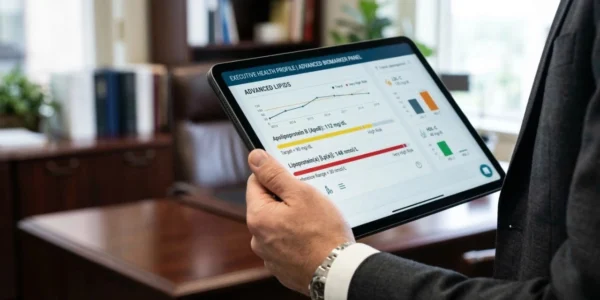
Understanding LDL, Lp(a), and Familial Hypercholesterolemia
For instance, Familial Hypercholesterolemia (FH)—a genetic predisposition to high LDL—can often go undetected in standard screenings if not specifically audited via advanced panels. FH affects approximately 1 in 250 individuals globally, yet remains vastly underdiagnosed. For an executive with FH, even a perfect diet and a rigorous exercise regimen may not be enough to reach target ldl levels. Early detection through comprehensive hyperlipidemia testing is the only way to intercept this genetic trajectory.
| Biomarker | Why It Matters in 2026 | Optimal Executive Range |
| LDL-C | The primary driver of arterial plaque | < 70 mg/dL (or < 55 for high risk) |
| ApoB | Measures the total number of “bad” particles | < 65 mg/dL |
| Lp(a) | A genetic risk multiplier (pro-thrombotic) | < 30 mg/dL (or < 75 nmol/L) |
| Triglycerides | Indicator of metabolic/sugar handling | < 100 mg/dL |
2026 American Heart Association Cholesterol Guidelines and the PREVENT Equation
Target LDL Levels by Risk Category
| Risk Category | Clinical Profile | Target LDL-C (2026 Standards) |
| Low Risk | No history, optimal PREVENT score | < 100 mg/dL |
| Moderate Risk | Metabolic syndrome or family history | < 70 mg/dL |
| High Risk | Confirmed plaque or familial hypercholesterolemia | < 55 mg/dL |
| Very High Risk | Recent cardiovascular event | < 40 mg/dL |
The PREVENT Equation: A New Standard for ASCVD Risk Assessment
Components of the PREVENT Score Audit:
- Kidney Function (eGFR): Recognizing the heart-kidney connection.
- Metabolic Health: Including Hemoglobin A1c (HbA1c) as a primary risk driver.
- Lipid Burden: Integrating ApoB and ldl cholesterol history.
Social Determinants: Accounting for environmental stress and lifestyle factors.
The Science of At-Home Testing: Accuracy Meets Convenience
Maintaining Confidentiality in the Digital Age
From Screening to Action: Innovative Cardiovascular Disease Prevention
Interventions: Lifestyle vs. Advanced Therapeutics
| Intervention Type | Examples | Primary Benefit |
| Lifestyle Changes | Zone 2 Cardio, High Fiber, Sleep Hygiene | Improves metabolic flexibility |
| Nutraceuticals | Omega-3 (EPA/DHA), Berberine, Stanols | Mild lipid modulation |
| Oral Statins | Rosuvastatin, Atorvastatin | Broad primary prevention of cardiovascular disease |
| Injectables (siRNA) | Inclisiran (Twice-yearly) | Maximum convenience for busy executives |
| PCSK9 Inhibitors | Evolocumab, Alirocumab | Drastic reduction in bad cholesterol levels |
Strategic lifestyle changes for cardiovascular disease management remain the foundation. Focusing on Zone 2 training improves mitochondrial function and lipid metabolism without the massive recovery tax of high-intensity workouts.
Why Executives Are Choosing At-Home ``Health Audits``
The ROI of Heart Health
- Cognitive Clarity: There is a strong link between vascular health and brain function.
- Sustained Energy: Proper metabolic health prevents energy crashes.
- Risk Mitigation: Avoiding a major event is the ultimate “insurance policy” for your career.
Integrating at-home screening through Doctor2me simplifies this process. Instead of the lab being a destination, it becomes a service that comes to you, integrating results directly into your digital health ecosystem.

Managing Hyperlipidemia in the Remote-First World
Many executives are lulled into a false sense of security by “normal” numbers. However, risk is multi-factorial. A “normal” LDL level in the presence of high stress or a family history of early heart disease may actually be dangerously high. This is why a professional ascvd risk assessment is vital.
Home-based testing allows for more frequent monitoring, enabling you to see how your body responds to specific lifestyle interventions in real-time. Did that new fasting protocol actually improve your triglycerides? Is your new travel schedule causing a spike in your LDL? At-home screening provides the answers.
Practical Steps for the Executive Health Audit
- Schedule a Comprehensive At-Home Panel: Ensure your panel includes LDL-C, HDL-C, Triglycerides, ApoB, and Lp(a).
- Utilize Concierge Services: Services like Doctor2me provide the professional oversight needed to ensure clinical-grade sample collection in the comfort of your home.
- Review the PREVENT Score: Work with a physician to calculate your 30-year risk based on the latest 2026 AHA metrics.
- Implement High-Yield Lifestyle Changes: Focus on Zone 2 cardio, high fiber, and sleep hygiene.
Consider Advanced Therapeutics: If lifestyle changes don’t bring you to your target ldl levels, discuss the latest long-acting therapies with your specialist.
The transition to at-home cholesterol screening represents a broader shift in how we view the human body. We are no longer passive recipients of medical care; we are active managers of our biological assets.
By leveraging the latest american heart association cholesterol guidelines, utilizing the precision of the ascvd risk assessment, and embracing the convenience of at-home services like Doctor2me, you can ensure that your cardiovascular system is as robust as your professional legacy.
Don’t wait for a “warning sign” that might come too late. Take the initiative to audit your heart health today, from the comfort of your home, and secure your performance for the decades to come.
Executive Insight: “The most successful leaders I know treat their health like their most important portfolio. They don’t guess; they measure. And they don’t wait for problems; they prevent them.”
Frequently Asked Questions
Why should I choose at-home cholesterol testing over a traditional clinic visit?
At-home screening minimizes logistical friction and eliminates “white coat hypertension,” which often skews results during a stressful clinic commute. Professional services like Doctor2me provide a discrete, clinical-grade experience that fits seamlessly into a high-performance executive schedule while ensuring total data privacy.
What is considered an optimal LDL cholesterol level according to 2026 guidelines?
For individuals focused on the primary prevention of cardiovascular disease, an ldl optimal level is typically below 100 mg/dL. However, for those with high-risk ascvd risk assessment scores or a history of arterial plaque, the latest american heart association cholesterol guidelines now recommend target ldl levels below 55 mg/dL.
Can familial hypercholesterolemia affect someone who maintains a healthy lifestyle?
Yes, familial hypercholesterolemia is a genetic condition that causes elevated bad cholesterol levels regardless of diet or exercise habits. Identifying this early through comprehensive hyperlipidemia testing is crucial for preventing long-term damage to your cardiovascular health that lifestyle alone cannot address.
What are the most effective lifestyle changes for cardiovascular disease prevention?
Incorporating Zone 2 aerobic training and high-fiber nutrition is essential for improving metabolic flexibility and optimizing your lipid profile. When combined with regular cholesterol testing, these high-yield habits form a robust defense against the “silent” buildup of plaque during your peak professional years.
How does the PREVENT equation differ from older heart disease risk calculators?
The 2026 PREVENT equations offer a sophisticated 30-year outlook on cardiovascular risk assessment by integrating kidney and metabolic health data. This shift allows for a much more proactive approach to cardiovascular disease prevention, identifying potential issues decades before a major event occurs.
Is an at-home lipid panel as accurate as a traditional hospital blood draw?
Modern at-home cholesterol testing technology has achieved a 97% correlation with traditional venous draws in 2026 clinical trials. This high level of accuracy, combined with the convenience of professional concierge collection, makes it a highly reliable tool for consistent cardiovascular health monitoring.