This content is for informational purposes only and does not substitute professional medical advice. Always consult a physician for diagnosis and treatment.
A board and care home and a large assisted living community can look worlds apart, yet in California they usually hold the same license.Both are licensed as an RCFE, so the real difference is size and feel, not the paperwork on the wall.
In the Conejo Valley, families weigh both models for a parent. One is a house with a handful of residents; the other is a bigger community with many.
Learning to read that shared license helps you compare them fairly. Here is how the two models stack up, and what the license can tell you about a home you are considering.
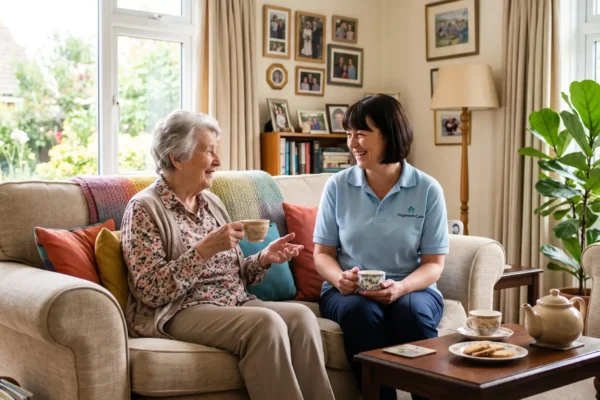
What Is the Difference Between Board and Care and Assisted Living?
The National Institute on Aging describes board and care homes as small facilities, usually with 20 or fewer residents, offering personal care and meals. Assisted living, by contrast, can range from about 25 residents to 100 or more.
Both help with daily tasks like bathing, dressing, meals, and medication reminders. Neither is a nursing home, and neither provides skilled medical care around the clock.
So the choice is less about services and more about setting. Do you want a quiet, home-like house, or a busy community with more amenities and people?
Both models exist all over the Conejo Valley, from Thousand Oaks to Westlake Village. Some families even tour one of each before they can feel the difference for themselves.
What Is an RCFE License, and Why Does It Matter?
The California Department of Social Services explains that an RCFE provides 24-hour non-medical care and supervision for people 60 and over. The terms assisted living, board and care, and RCFE all point to the same license type.
This matters because the assisted living license and the board and care license are not really two different things. Knowing that keeps you from assuming one is safer or more official than the other.
A small home you might tour in Thousand Oaks, like Arianah Place, carries the same RCFE license as a large community, just for fewer residents.
How Do You Read the License Behind a Home?
The state’s Facility Search tool lets you find a home, confirm its license is current, and read its licensing reports. This is the single best way to check a place beyond the tour.
When you look up a license, pay attention to a few things:
- That the license is active and in good standing
- The licensed capacity, which tells you the home’s size
- Any substantiated complaints and how they were resolved
- The dates of recent inspection visits
You can also ask the home directly to see its most recent reports. A confident, well-run home will not hesitate to share them.
Is a Small Board and Care or a Large Community Better?
When a Small Board and Care Home Shines
Strengths families often notice:
- Fewer residents and more personal attention
- A calm, home-like environment that is easy to navigate
- Consistent caregivers who know each resident well
- Simple, familiar routines
A small home such as Land of Enchantment Board and Care in Thousand Oaks shows this model: a handful of residents in a real house, not a wing of a building.
When a Larger Community Makes Sense
Common advantages include:
- A wide activity and events schedule
- On-site dining, salons, and common spaces
- More staff coverage and often on-site nursing oversight
- Room to move up in care without leaving
A community like Royal Oaks Inn, a larger assisted living option in Thousand Oaks, shows the other end of the range, with more space and more people.
What About Memory Care in the Conejo Valley?
The Alzheimer’s Association notes that memory care units may be secured or unsecured and vary widely, so it is important to ask exactly what dementia care a home provides.
Sorting through dementia care choices is hard to do alone. A dementia care specialist like Dementia Partner can help a family understand a loved one’s needs and match them to the right setting.
Ask each home whether its memory care area is secured, how staff are trained for dementia, and how they handle confusion or wandering. The answers vary a lot between homes of the same license.
What Should You Verify Before You Decide?
Run through a short checklist for each home you like:
- Confirm the RCFE license is current and matches the address
- Check the licensed capacity so you know the true size
- Read the recent inspection reports and any complaints
- Ask what level of care triggers a higher fee
- Ask whether your loved one can stay as needs change
- Ask about staff training and how long caregivers have stayed
Also notice the human side that no report captures. How does the staff speak to residents, and does the home feel calm, clean, and cared for?
Try to visit more than once, including a mealtime and a quiet evening. A single scheduled tour rarely shows you everyday life.
How Do You Choose the Right Fit?
Comparing small homes and large communities at once can feel like a lot. A senior transition service such as Senior Home Transitional Services can help you shortlist homes in the Conejo Valley that fit your loved one.
If your parents hope to stay home a while longer, that is worth planning too. This guide on how to prepare a senior’s home for aging in place covers simple changes that keep a house safer.
Remember that an RCFE is non-medical, so residents keep their own doctors. Some families arrange a doctor who visits the home in person, which makes routine care far easier for a resident who no longer drives.
Whatever you choose, visit at different times and trust what you see and feel. A license tells you a home is legitimate; your own eyes tell you if it is right.
Frequently Asked Questions
What is the difference between board and care and assisted living?
Mostly size. A board and care home is small and house-based, usually with 20 or fewer residents, while assisted living is a larger community. In California, both are licensed as an RCFE and offer similar non-medical help with daily tasks.
Do board and care homes and assisted living have the same license?
Yes. In California, both are licensed as a Residential Care Facility for the Elderly, or RCFE. The terms assisted living, board and care, and RCFE all describe the same license type.
How do I check a home’s RCFE license?
Use the California Department of Social Services Facility Search tool. It shows whether a license is current, the home’s capacity, inspection reports, and any substantiated complaints.
Is a small board and care home safer than a large community?
Not automatically. Both must meet the same state licensing rules. A small home offers more personal attention, while a large community offers more amenities. Safety depends on the specific home, not its size.
Are there board and care homes for seniors in Thousand Oaks?
Yes. The Conejo Valley has many small board and care homes and larger assisted living communities, all licensed as RCFEs. Comparing a few in person is the best way to find the right fit.
Does an RCFE provide medical care?
No. An RCFE provides non-medical care and supervision, not skilled nursing. Residents keep their own doctors, and some families arrange for a physician to visit the home.