This content is for informational purposes only and does not substitute professional medical advice. Always consult a physician for diagnosis and treatment.
A hearing test after 70 is quick, painless, and one of the most useful checkups you can do. It usually takes place in a quiet sound booth, where you listen for soft tones and repeat a few words. In well under an hour, you learn exactly how well you hear.
If you have been putting it off, you are in good company. Age-related hearing loss creeps in slowly, so many people do not notice it until a family member does. Booking a test is the simplest way to get a clear answer.
Here in the Conejo Valley, hearing tests are easy to find and nothing to dread. Let us walk through what really happens, step by step.
Why Get a Hearing Test After 70?
Part of the problem is how quietly it starts. The NIDCD explains that age-related hearing loss, called presbycusis, comes on gradually and usually affects both ears, so you may not realize how much you have lost.
Untreated hearing loss is not just about missed words. The National Institute on Aging links it to social isolation, a higher risk of falls, and faster cognitive decline. Catching it early gives you the best chance to stay connected and safe.
There is also a simple, hopeful reason to go. Once you know where your hearing stands, you can do something about it. A test turns a vague worry into a clear plan you can act on.
Signs It Might Be Time for a Hearing Test
- Ask people to repeat themselves more than you used to
- Struggle to follow a conversation when several people talk
- Turn the TV up louder than others in the room
- Have trouble hearing on the phone or in noisy places
- Feel that people mumble, or miss higher-pitched voices
One or two of these now and then is normal. A steady pattern, though, is your cue to get checked rather than to keep guessing.
What Actually Happens During a Hearing Test?
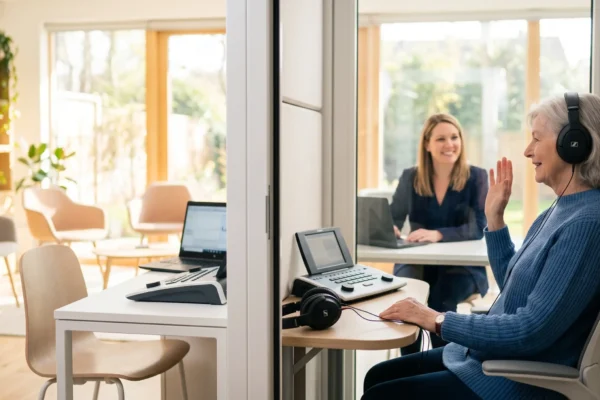
First, the provider asks about your history and looks in your ears to rule out something simple, like earwax. Then the listening tests begin. The whole visit usually runs 30 to 60 minutes.
The booth is soundproofed so outside noise does not throw off the results. It can feel a little quiet there, which is exactly the point. That silence lets the softest sounds stand out.
The Sound Booth and the Beeps
This maps the softest sounds you can hear at each pitch. Sometimes a small headband is used to send sound through the bone behind your ear, which helps pinpoint where the trouble is.
The Word-Repeating Part
What Is an Audiogram?
The pattern tells the story. It shows whether your hearing is normal or reduced, how much is lost, and which pitches are affected. High-pitched sounds, like children’s voices, are often the first to fade, which is why you might hear that someone is talking but still miss the words.
Numbers give it scale. The World Health Organization defines disabling hearing loss as more than 35 decibels in the better ear, and your audiogram shows exactly where you land against that mark.
Does It Hurt, and How Long Does It Take?
Most appointments take about half an hour to an hour, including the chat at the start and the results at the end. If an online hearing test or a phone-app screen prompted you to come in, the booth test gives a far more precise picture.
How to Prepare for Your Hearing Test
- Jot down when and where you notice trouble hearing
- Bring a list of your medications, since some can affect hearing
- Mention any ear pain, ringing, or dizziness
- Bring a family member if you would like a second set of ears
- Clean, dry ears help, but do not use cotton swabs beforehand
Arriving a few minutes early gives you time to settle in. The calmer you are, the easier it is to focus on those faint beeps.
What Do the Results Mean?
Type matters too. Conductive loss involves the outer or middle ear, sensorineural loss involves the inner ear or nerve, and some people have a mix of both. Knowing the type points to the right next step.
If your hearing is normal, that is a great baseline to keep on file. If there is loss, the results become the roadmap for what helps. Your provider will walk you through the graph in plain language, so you leave understanding it rather than guessing.
Who Does Hearing Tests, and Do You Need a Referral?
A family doctor is a fine starting point if you are unsure. A quick video visit can even open the conversation and point you toward a local hearing test. Many clinics offer a free hearing screening, so it is worth asking when you call.
Getting there is not always simple. If leaving home is hard, a doctor can come to you to check the basics and help arrange the next step.
What Happens After the Test?
The NIDCD notes that hearing aids now come two ways. Over-the-counter devices can help with mild to moderate loss, while a professional fits and adjusts devices for more complex or severe loss. There is no one-size-fits-all answer, which is why the test comes first. The right choice depends on your degree of loss, your lifestyle, and what you want to hear better, whether that is grandchildren, the phone, or a favorite show.
Treating hearing loss may do more than sharpen sound. Because it is tied to faster cognitive decline, acting early may help protect the brain. Families juggling both hearing loss and memory changes sometimes lean on a dementia care coach like Dementia Partner, who helps them cope and plan.
Getting to Your Hearing Test in Conejo Valley
Some families plan ahead for the ride. Others look into non-emergency medical transportation and whether Medicare covers it, so a missed appointment never gets in the way of care. A little planning keeps the day low-stress.
For simple lab work and follow-ups, at-home options in Westlake Village can also cut down on trips. The goal is to make staying on top of your health as easy as possible.
A hearing test is a small step with a big payoff. It protects your connections, your safety, and your confidence in everyday conversation. If it has been a while, this is a good week to book one.
Frequently Asked Questions
Are online hearing tests accurate?
Online and app-based tests are a handy first screen, but they are not a diagnosis. Background noise and cheap earbuds can skew the result. A booth test with calibrated equipment gives the real picture.
Do you have to pay for a hearing test?
It depends on where you go. Many clinics offer a free hearing screening, while a full diagnostic test may carry a cost. It is smart to ask about pricing when you book.
Can I bring someone with me?
Yes, and it often helps. A family member can take notes, help you recall the results, and join the conversation about next steps.
How often should I get my hearing checked after 70?
For older adults, a check every one to three years is a reasonable rhythm. Go sooner if you notice new trouble following conversations or keep turning up the volume.
What is the difference between a screening and a full hearing test?
A screening is a quick pass-or-fail check for whether you might have a problem. A full hearing test maps your exact hearing across pitches and gives you an audiogram.
Will I need a hearing aid if I do not pass?
Not necessarily. It depends on the degree and type of loss. Some milder losses are managed with communication strategies and small changes rather than a device.