This content is for informational purposes only and does not substitute professional medical advice. Always consult a physician for diagnosis and treatment.
A TSH test is the first thyroid check, and normal runs about 0.4 to 4.8. Many labs allow a higher ceiling after 60.
MedlinePlus (2026) gives the normal TSH range as 0.4 to 4.8 microunits per milliliter and notes that some laboratories use a higher upper limit for older people, with ranges varying slightly between labs. That single sentence explains a lot of the confusion people bring home from an appointment.
The second half of the confusion is what to do when the number looks fine and you still feel wrecked. This piece covers what TSH actually measures, which tests come next, what a mildly raised result usually means, and why a careful doctor sometimes chooses to wait.
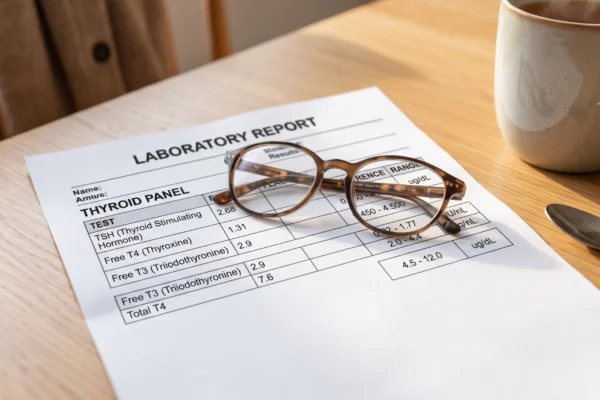
What Does a TSH Test Measure?
MedlinePlus (2024) describes TSH as the hormone the pituitary gland makes to control how much hormone the thyroid produces, and notes that a level which is too high or too low may be a sign of a thyroid problem. It also states plainly that the test cannot show what is causing one.
That is the key limitation to carry into the appointment. TSH is a screening signal rather than a diagnosis, and a result outside the range is the start of the investigation rather than the end of it. Nobody should be treated, or sent home reassured, on this one number alone.
What Do High TSH and Low TSH Mean?
Low TSH works the other way, and the list of causes is longer than most people realise. MedlinePlus (2026) lists Graves disease, toxic nodular or multinodular goiter, excess iodine such as from CT contrast, and taking too much thyroid hormone medicine among the possibilities.
Why an Odd Result Is Not Always Thyroid Disease
Medications matter too, and more of them than patients expect. MedlinePlus (2026) lists steroids, dopamine, some chemotherapy drugs, and opioids among the treatments that can lower TSH, which is why bringing a full medication list to the blood draw is not a formality but part of getting a readable result.
Which Thyroid Tests Should You Ask For?
Knowing what each test is for also makes it easier to ask for the right one rather than asking for everything. The table below pairs each test with what it shows and when it is usually ordered, so you can see where your own results fit in the sequence.
| Test | What it shows and when it is ordered |
|---|---|
| TSH | The pituitary signal to the thyroid. Checked first. High usually means an underactive thyroid, low usually means an overactive one, and it cannot show the cause. |
| Free T4 | The unbound form of the thyroid's main hormone. Ordered alongside TSH when results are abnormal or symptoms are present. A typical range is 0.8 to 1.9 ng/dL, varying by lab. |
| T3 (free or total) | Mainly used when an overactive thyroid is suspected. It is not commonly used to check for hypothyroidism, because other tests pick that up earlier. |
| Thyroid antibodies | Ordered when an autoimmune cause is suspected, to help identify conditions such as Hashimoto disease or Graves disease. Usually requested after the first round of blood tests. |
Free T4, and What Can Skew It
The same page lists what can shift the result: pregnancy and estrogen levels, kidney and liver disease, severe whole-body illness, inherited changes in the protein that binds T4, biotin supplements, and certain medicines your provider may ask you to stop before testing.
Biotin is the one worth flagging, because it turns up in hair, skin and nail supplements that people do not think of as medication at all. Mention every supplement you take when the blood draw is booked, not afterward when the result already looks odd.
Where T3 Fits
It also makes the negative case clear. The page states that T3 testing is not commonly used to help check for hypothyroidism, because other thyroid tests usually detect it earlier, and that normal T3 alone does not rule out thyroid disease.
Which Symptoms Get Blamed on Age Instead?
MedlinePlus (2024) lists early signs of hypothyroidism as hard stools or constipation, feeling cold, fatigue or feeling slowed down, joint or muscle pain, paleness or dry skin, sadness or depression, thin brittle hair or fingernails, weakness, and weight gain.
Later Signs That Are Harder to Explain Away
Risk rises with the decades, which is the practical argument for testing rather than assuming. MedlinePlus notes that hypothyroidism is more common in women and in people over age 50, so several of these symptoms arriving together after 60 is a reason to ask for the blood test.
What If Your TSH Is Normal and You Still Feel Wrecked?
Ask for the Second Layer of Testing
Beyond the thyroid, persistent fatigue after 60 has a short list of other usual suspects worth ruling out, and some of them look remarkably similar. Our piece on late-onset lupus and the ANA test covers one of them and why it gets mistaken for ordinary aging.
Treating the Person, Not Only the Number
Repeat testing also has a role here. A TSH drifting upward across three readings tells a different story from one borderline value, and keeping your own copies of each result is the simplest way to make that trend visible to whoever sees you next.
What Does Subclinical Hypothyroidism Mean?
Cleveland Clinic (2025) describes it as elevated TSH with normal thyroxine, and sorts it into grade 1 at a TSH of 4.5 to 9.9 mIU/L and grade 2 at 10 mIU/L or higher. That grading is what a doctor is weighing when they decide whether to act.
Why Waiting Is Often the Plan
Treatment is not automatic, and it is not withheld arbitrarily either. The same page says the decision depends on TSH level, symptoms and overall health, that most people are advised to wait and see, and that treatment may be recommended at a TSH of 10 mIU/L or higher or for symptomatic younger and middle-aged adults.
So a doctor who suggests rechecking in three months is following the usual approach rather than putting you off. Asking when the repeat test is booked, and what number would change the plan, turns that wait into something you can hold them to.
How Is a Thyroid Problem Treated?
What is worth knowing beforehand is the rhythm of it. Levels are usually rechecked a set number of weeks after any change, because the blood needs time to settle, and the aim is a stable result rather than a fast one.
Continuity of care matters more here than in most things, because the adjustments depend on someone holding the whole history. Zhanna Feldsher, MD practices family and internal medicine across Thousand Oaks and the surrounding areas, which is the kind of ongoing relationship this sort of follow-up asks for.
Can You Do a Hypothyroidism Test at Home?
Why a Lab Draw Beats a Mail-Order Kit
Our walk-through of at-home blood draws and how mobile phlebotomy works covers who benefits most, which common tests can be drawn at home, and how to prepare for the appointment. For anyone who finds the trip harder than the test, it is the part worth arranging first.
The discussion of results does not need to happen in a clinic either. A video appointment is well suited to going through numbers and deciding the next step, and our piece on what a video visit covers sets out where it works and where it does not.
What Should You Bring to the Appointment?
Previous results carry the most weight of the three. A trend across readings answers questions a single value cannot, and it saves a repeat test that would tell your doctor nothing new. Ask the lab or the portal for copies if you do not already keep them.
If getting to the office is the barrier, the whole sequence can happen at home. A doctor who visits at home can take the history, order the blood work, and go through the results without anyone having to plan a day around a waiting room.
Frequently Asked Questions
Does the time of day affect a TSH result?
It can vary through the day, which is one reason borderline results are often repeated. Having repeat tests drawn at a similar time of morning makes the comparison cleaner.
Do I need to fast before a thyroid blood test?
Usually not for TSH alone, but confirm with the ordering office because other tests drawn at the same visit may require it. Ask when you book rather than in the morning.
Can a thyroid problem cause weight gain on its own?
It contributes rather than explains everything. Treating an underactive thyroid often reverses some weight gain, but rarely all of it, and expecting more than that leads to disappointment.
Is a goiter always visible?
No. An examination may find an enlarged thyroid, but the gland can also be normal or smaller than normal in hypothyroidism, which is why the diagnosis rests on blood tests rather than on the neck exam.
Should an older adult with a slightly high TSH be treated the same as a younger one?
Not necessarily, and that is a deliberate difference rather than neglect. Age, symptoms, other conditions and the exact TSH value all feed into the decision, so ask what specifically is driving the recommendation in your case.
How long after starting treatment should I feel different?
It is usually gradual rather than sudden, and blood levels are rechecked after a set interval before anything is adjusted. Keep a short note of symptoms between visits so the follow-up has something to work with.
Sources Used
Hypothyroidism – MedlinePlus (2024)
Subclinical Hypothyroidism – Cleveland Clinic (2025)
Triiodothyronine (T3) Tests – MedlinePlus (2024)
TSH (Thyroid-stimulating hormone) Test – MedlinePlus (2024)
TSH test – MedlinePlus (2026)
Graves’ disease – Symptoms and causes – Mayo Clinic (2024)