This content is for informational purposes only and does not substitute professional medical advice. Always consult a physician for diagnosis and treatment.
Rough scaly patches on skin that have had years of sun are usually actinic keratosis. It is a precancer rather than cancer, and it is treatable.
It is also extremely common. According to Cleveland Clinic (2025), more than 40 million Americans develop actinic keratosis each year, and it is the most common type of skin precancer. MedlinePlus puts the other half of the picture plainly: a small number of these growths turn into squamous cell carcinoma.
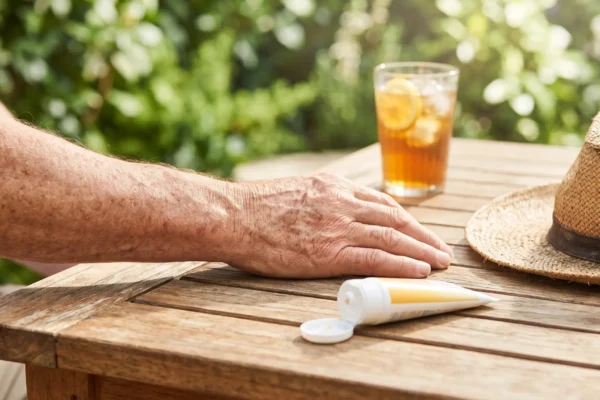
What Do Rough, Scaly Patches From Sun Damage Look Like?
MedlinePlus, in an entry reviewed in October 2024, describes the skin changes as starting flat and scaly, often with a white or yellow crusty scale on top. The growths may be gray, pink, red or the same color as the surrounding skin, and later turn hard and wart-like or gritty and rough.
That last detail explains why these spots get missed for years. MedlinePlus notes the affected areas may be easier to feel than see, which is why people often find them while shaving, washing their face or running a hand over a scalp.
Cleveland Clinic adds the symptoms that bring people in: an area that is itchy, tender or painful to the touch, burning or stinging, uncomfortable under clothing, or occasionally bleeding. Some look like an acne breakout at first, and some get mistaken for a scab or sore that will not heal.
Where They Show Up on the Body
MedlinePlus adds the chest to that list. Sun damage on the face and the back of the hands tends to be the first place anyone notices, because those are the two areas a person looks at every day.
A bald or thinning scalp is the site people forget entirely. It gets direct overhead sun for decades with nothing in the way, and it is hard to inspect without a mirror and some patience.
Are Age Spots Scaly, or Is This Something Different?
Mayo Clinic, in a page dated May 2025, describes age spots as flat, oval areas of increased pigmentation, usually tan to dark brown, ranging from freckle size to about half an inch across. They are also called sunspots, liver spots or solar lentigines, and Mayo Clinic notes that true age spots do not require medical care.
So texture is the home test, not color. Both conditions are a record of sun exposure and both favor the same areas, but pigmentation sits flush with the skin while actinic keratosis sits slightly above it and feels dry.
There is one age-spot exception worth knowing. Mayo Clinic advises having a doctor look at spots that are black or have changed in appearance, because those changes can be signs of melanoma. A flat brown spot that stays the same for years is a different matter from one that is darkening or growing.
Is Actinic Keratosis Precancerous, or Is It Cancer?
The cancer it can turn into has a name. MedlinePlus explains that actinic keratosis is a precancerous lesion that may become squamous cell skin cancer, the second most common cancer in the United States, which affects the epidermis, the top layer of skin.
The honest version of the risk is reassuring and also a reason to act. Most actinic keratoses are treated before they reach the cancer stage, according to Cleveland Clinic, and MedlinePlus says only a small number turn into squamous cell carcinoma. Nobody can tell which ones from looking, which is the whole argument for treating them.
One signal does deserve faster attention. MedlinePlus notes that a sore that does not heal can be a sign of squamous cell cancer, and that any change in an existing wart, mole or other skin lesion could be a sign of skin cancer. A spot that bleeds, grows or stops healing is not a wait-and-see spot.
What Are the Treatment Options for Actinic Keratosis?
Cleveland Clinic lists cryotherapy for actinic keratosis as the usual choice when there are only a few. Liquid nitrogen freezes the spot off during an office visit, and the area may blister and peel away over the following few days. It is quick, done without an overnight stay, and the main cost is a few days of a sore-looking patch.
For multiple or recurring spots, Cleveland Clinic describes photodynamic therapy, which uses a light-sensitive cream plus a special light, and requires avoiding sunlight for a few days while the skin heals. Laser therapy, chemical peels and curettage, where the provider scrapes or burns the damaged area away, cover other situations.
Surgical excision is the option when a spot needs to be removed whole. The area is numbed, stitches may be used, and Cleveland Clinic says the skin usually heals in two to three weeks. MedlinePlus lists the same core set, including burning, curettage with electrodesiccation, excision and freezing.
Field Therapy, and Why It Looks Worse Before It Looks Better
Cleveland Clinic describes prescription creams and gels applied at home over several weeks to a few months, which treat an area rather than a single lesion. The same source notes these treatments can cause skin discoloration, peeling or irritation while they work, and that a provider gives instructions on what to expect.
People stop early because the mirror looks alarming around week two. Knowing in advance that the redness and peeling are the expected course, and asking the provider how far it should go before it is worth a call, is what gets most people through the full round.
Comparing the Common Treatments
| Approach | Best suited to | What to expect afterward |
|---|---|---|
| Cryotherapy (freezing) | A few isolated spots | The area may blister and peel off over a few days |
| Photodynamic therapy | Multiple or recurring spots | Avoiding sunlight for a few days while the skin heals |
| Prescription cream or gel at home | A whole sun-damaged area | Weeks to a few months of use, with peeling and irritation as it works |
| Curettage, laser or chemical peel | Thicker or larger damaged areas | The top layer peels and new skin forms as it heals |
| Surgical excision | A single spot that needs removing whole | Numbing, possible stitches, healing in two to three weeks |
Will the Spots Come Back After Treatment?
Healing itself is usually quick. Most actinic keratoses heal within a few weeks of treatment, according to Cleveland Clinic, with the exact timing depending on which approach was used.
The follow-up is the part that matters long term. Cleveland Clinic recommends seeing a provider once or twice a year for regular skin checkups even after the spots clear, because the risk of new spots and of skin cancer does not reset. A new or unusual spot between visits should be checked rather than saved for the annual appointment.
How Do You Stop New Ones From Forming?
Cleveland Clinic’s prevention list is short and specific: wear sunscreen with SPF 30 or above every day, including when it is cloudy or cold; stay out of the sun between 10 a.m. and 4 p.m. when UV rays are strongest; wear long sleeves, long pants, a wide-brimmed hat and sunglasses; and avoid tanning beds and indoor UV lamps.
Some risk factors cannot be changed, and knowing yours changes how closely you watch. MedlinePlus lists fair skin, blue or green eyes, blond or red hair, many severe sunburns early in life, daily outdoor work and older age, along with having had a kidney or other organ transplant or taking medicines that suppress the immune system.
Living in the Conejo Valley puts a thumb on the scale. Cleveland Clinic notes that living closer to the equator raises the risk, and Southern California delivers usable sun most of the year, which is pleasant and also cumulative.
What a Skin Cancer Screening Visit Actually Involves
A primary care physician or a dermatologist can usually make the diagnosis by examining the skin, according to Cleveland Clinic, using a tool that magnifies the surface for a better look. If anything is uncertain, a small piece of skin goes to a lab, which is called a skin biopsy. MedlinePlus is firm that a biopsy must be done to confirm squamous cell skin cancer.
Screening has limits worth hearing before you go. The National Cancer Institute’s summary on skin cancer screening, updated in May 2025, lists false-negative and false-positive results among the risks, along with scarring from a biopsy, and notes that screening is looking for cancer before any symptoms appear.
Starting with a primary care doctor is often faster than waiting for dermatology. A family physician such as Zhanna Feldsher, M.D., who sees patients around Thousand Oaks and the west side, can look at a patch, treat the straightforward ones and write the referral when a specialist is the right next step.
Getting Seen Without Spending a Day on It
Who you can see without a referral depends on your coverage, and our explainer on how an HMO or a PPO picks your specialists covers which plans need one first. A referral for dermatology is routine, but it adds a step and a wait.
Video visits are part of this job. A camera can start the conversation and sort out what needs hands-on attention, and our pieces on seeing a specialist without driving and on what a video visit covers explain where the limits sit. Texture is hard to judge through a screen, so a rough patch usually still earns an in-person look.
If blood work comes out of the visit, that part does not always mean another trip. Our overview of at-home blood draws in Westlake Village explains how mobile phlebotomy works, and for someone who struggles to get to an office at all, a physician who visits at home can handle the exam and the referral in one stop.
Frequently Asked Questions
Can actinic keratosis show up on the lip?
Yes, and it has its own name. Cleveland Clinic describes actinic cheilitis as dry, cracked or white areas on the lower lip that may burn, peel or fail to heal. The lower lip takes direct sun and is easy to forget when applying protection.
Does a rough patch like this hurt?
Sometimes. Cleveland Clinic lists itching, tenderness, pain to the touch, burning or stinging among the symptoms, along with spots that are uncomfortable under clothing. Plenty of them cause nothing at all, which is why texture matters more than sensation.
Can tanning beds cause this, not just the sun?
They can. Cleveland Clinic names frequent use of indoor tanning equipment alongside sun exposure as a cause, because both deliver the ultraviolet light that damages DNA in skin cells. Years of tanning-bed use can produce the same spots as years outdoors.
Why would an organ transplant raise the risk?
Because of the medicines that come with it. MedlinePlus lists having had a kidney or other organ transplant, and taking medicines that suppress the immune system, among the risk factors, and Cleveland Clinic lists a compromised immune system. A weaker immune response gives abnormal cells more room.
Is a biopsy always needed to know what a spot is?
No. Cleveland Clinic says a provider can usually diagnose actinic keratosis by examining the skin, with a biopsy only when a sample is needed. For squamous cell skin cancer, MedlinePlus says a biopsy is required to confirm the diagnosis.
Does sunscreen in January really make a difference?
Cleveland Clinic recommends SPF 30 or above every day, including when it is cloudy or cold, which answers the question directly. Ultraviolet light reaches skin through overcast weather, and the damage that produces these spots accumulates across years rather than summers.
Sources Used
Actinic keratosis – MedlinePlus, National Library of Medicine (2024)
Age spots (liver spots) – Mayo Clinic (2025)
Skin Cancer Screening (PDQ) – Patient Version – National Cancer Institute (2025)
Squamous cell skin cancer – MedlinePlus, National Library of Medicine (2025)
What Are Precancers and Precancerous Cells? – American Cancer Society (2025)
How to Prevent Sunburn – Cleveland Clinic (2023)