This content is for informational purposes only and does not substitute professional medical advice. Always consult a physician for diagnosis and treatment.
Preventing catastrophic falls in the bathroom requires a strategic combination of clear architectural layouts, high-traction surfaces, and medical-grade supportive equipment. Creating a safe environment is not merely about adding a single grab bar; it is about systematically eliminating environmental hazards that challenge the changing biomechanics of an aging body.
By assessing the space through a clinical lens, families can implement precise modifications that protect independence and significantly reduce the risk of severe injuries.
Why the Bathroom is the Ultimate Danger Zone for Older Adults
The Biomechanics of Aging and Balance
- Decreased Step Length Index: This creates a more unstable, shuffling gait that struggles to adapt quickly to sudden changes in floor traction or elevation.
- Reduced Proprioception: The joints and muscles send slower signals to the brain regarding spatial positioning, delaying protective reflex actions.
- Lower Extremity Weakness: A natural decline in quadriceps and calf muscle density makes vertical transitions (like standing up from a seated position) significantly more difficult.
The Hidden Dangers of Wet Surfaces
Women frequently slip while walking across wet tiles, which can result in devastating pelvic or hip fractures. Clinical data shows that 88% of all hip fractures are caused directly by falls. Understanding how to proactively prevent these incidents is essential for avoiding prolonged hospitalizations and loss of mobility.
The Core Architectural Blueprint: Space and Accessibility
Doorway Clearance and Approach
- Minimum Clear Width: A clearance of exactly 81 centimeters is strictly required to comfortably pass through with walkers, rollators, or standard wheelchairs.
- Swing-Clear Hinges: If the current frame is too narrow, installing specialized offset hinges can instantly add valuable clearance space without the need for expensive structural reconstruction.
- Door Removal Options: In cases of severe mobility restriction, removing the traditional door and installing a weighted privacy curtain completely eliminates the need to maneuver around a swinging barrier.
Floor Thresholds and Maneuvering Space
Key metrics for internal space include:
- Turning Radius: A 152-centimeter circular turning space allows for completely safe mobility, ensuring an individual can turn around smoothly without dangerously backing up.
- Threshold Limits: The maximum allowable threshold height is exactly 13 millimeters.
- Beveling: Any height transition between the hallway and the bathroom floor must be smoothly beveled to prevent shuffling feet from catching the edge.
Essential Protective Gear: Functional Bathroom Upgrades
Evaluating Structural Needs Versus Temporary Fixes
Key Safety Modifications and Their Biomechanical Benefits
| Equipment Category | Primary Function | Clinical Safety Benefit |
| Wall-Anchored Supports | Stability during weight shifting | Prevents slips during vertical transitions |
| Waterproof Seating | Resting during hygiene routines | Reduces fatigue and orthostatic dizziness |
| Anti-Slip Floor Tech | Enhancing surface traction | Provides a secure grip on wet tiles |
| Height Modifications | Elevating low surfaces | Reduces stress on knee and hip joints |
Securing the Shower: Eliminating Tub Hazards
Installing Wall-Anchored Supports
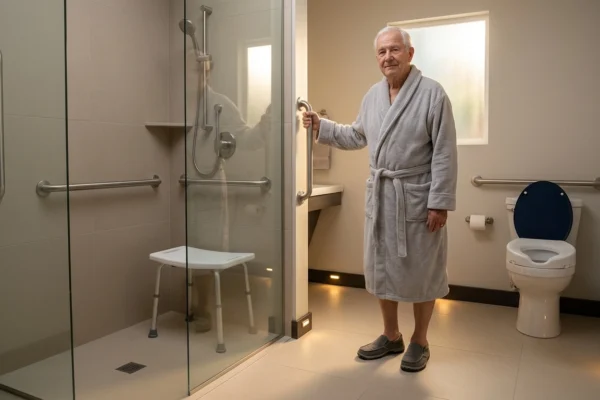
- Horizontal Placement: Primary bars should be mounted exactly 84 to 91 centimeters from the floor to align with natural hand positioning.
- Vertical Entry Bars: Vertical bars placed at the point of entry provide critical assistance when stepping over the tub wall.
- Structural Anchoring: Consulting with specialized home modification installers ensures that every fixture is anchored directly into the wooden studs, guaranteeing it can support up to 113 kilograms of sudden downward force without damaging the drywall.
Implementing Seating Solutions
- Stability Features: A bath safety seat for an elderly family member must feature wide, non-slip rubber tips on all legs.
- Drainage: The seat must have strategically placed drainage holes to prevent water pooling, which reduces surface friction.
- Accessory Integration: Pairing the seat with a handheld showerhead attached to a 150-centimeter flexible hose allows the individual to wash thoroughly while remaining safely seated.
Toilet Ergonomics and Joint Support
The Importance of Proper Elevation
- ADA-Compliant Fixtures: Installing an ADA-compliant comfort height fixture measuring 43 to 48 centimeters from the floor aligns perfectly with natural body mechanics.
- Elevated Add-Ons: If replacing the porcelain toilet is not viable, securely attaching a raised toilet seat for seniors instantly provides the necessary elevation. Sourcing medical supplies from specialized retailers, guarantees that the unit locks firmly onto the bowl without shifting, wobbling, or cracking during daily use.
Automated Systems for Hands-Free Hygiene
- Bidet Systems: Introducing automated bidet systems significantly enhances both safety and personal dignity by eliminating the need for excessive spinal rotation.
- Infection Control: Maintaining meticulous automated hygiene lowers the risk of severe urinary tract infections, a condition that frequently causes sudden confusion and dramatic secondary falls in elderly patients.
Visual Navigation and Smart Lighting Adjustments
Circadian Lighting and Nighttime Navigation
- Motion-Activated Pathways: Installing amber or red floor lighting illuminates the path to the toilet without disrupting melatonin production or causing pupil shock.
- Shadow Reduction: Use multiple ambient light sources rather than a single overhead bulb to eliminate harsh shadows that can be easily mistaken for steps or obstacles.
- Glare Prevention: Avoid high-gloss paint or extremely shiny tiles that reflect ceiling lights directly into the eyes.
Utilizing High-Contrast Colors
Next-Generation Innovations: Radars and Nanotechnology
Privacy-Preserving Fall Detection Sensors
- Non-Invasive Monitoring: They use 60 GHz radar frequencies to monitor movement patterns without the use of invasive cameras, preserving absolute visual privacy.
- Automated Alerts: They detect falls with exceptional accuracy and immediately trigger a local alarm or send an alert directly to a family member’s smartphone, ensuring rapid response times.
Micro-Pore Anti-Slip Floor Treatments
Medical Assessments and Convenient In-Home Care
Clinical Risk Evaluations and the STEADI Algorithm
- Screening: Identifying patients who have fallen in the past year or feel unsteady when standing.
- Assessing: Conducting the Timed Up and Go test to accurately evaluate gait stability, lower body muscle strength, and protective reflex speed.
- Intervening: Recommending targeted physical therapy interventions or specific structural modifications based on the biomechanical assessment.
Stress-Free Medical Consultations at Home
Medical services like Doctor2me allow patients to receive comprehensive, expert clinical care directly in their own living room.
The Final Checklist for Safe and Independent Living
| Safety Area | Action Required | Frequency |
| Floor Surfaces | Ensure pathways are completely free of clutter, towels, and wet spots | Daily |
| Support Bars | Test all wall anchors for any signs of loosening or structural stress | Monthly |
| Ambient Lighting | Check motion sensors and immediately replace any dimming LED bulbs | Bi-Monthly |
| Safety Seating | Inspect rubber grips on shower chairs for cracking or asymmetrical wear | Quarterly |
Final Thoughts
Frequently Asked Questions
What is the most essential bathroom safety equipment for an elderly person?
To ensure secure aging in place, the most critical upgrades include structurally anchored grab bars, a stable bath safety seat, and a raised toilet fixture. These specific home modifications directly address daily mobility challenges and significantly reduce the risk of severe slips on wet surfaces.
Where exactly should bathtub safety bars for seniors be placed?
Horizontal supports must be mounted at a comfortable gripping height, typically between 33 to 36 inches (84 to 91 centimeters) from the floor. Additionally, vertical grab bars should be installed right at the point of entry to assist the user with stepping over the high tub wall safely.
How high should a raised toilet seat for seniors be?
An ideal ADA-compliant comfort height toilet should measure roughly 17 to 19 inches (43 to 48 centimeters) from the floor to the top of the seat. This specific elevation minimizes knee joint stress and allows older adults to transition from sitting to standing without requiring immense muscle effort.
Are suction cup grab bars safe for fall prevention?
No, temporary suction-cup devices are inherently unstable and highly dangerous because they can easily detach under full body weight. For reliable injury prevention, you must use heavy-duty metal bars that are permanently anchored directly into the structural wooden wall studs.
How can I make a shower stall completely slip-proof?
Eliminating wet floor hazards involves replacing standard rubber mats with advanced micro-pore anti-slip surface treatments that chemically activate upon contact with water. Pairing this modern flooring technology with a sturdy shower seat for a bathtub ensures maximum traction and stability during daily hygiene routines.