This content is for informational purposes only and does not substitute professional medical advice. Always consult a physician for diagnosis and treatment.
Monitoring your blood pressure accurately at home requires sitting quietly for at least five minutes, using a clinically validated upper-arm cuff on a bare arm, and taking double readings to ensure consistency. While a single high reading in a doctor’s office can be misleading due to stress, home bp monitoring provides a comprehensive look at your cardiovascular health over time.
By mastering the correct way to measure blood pressure at home, you can differentiate between temporary spikes and chronic hypertension, allowing for more precise medical interventions.
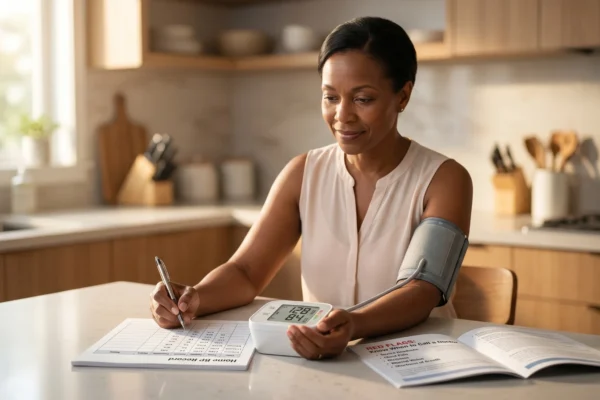
Why Home BP Monitoring is the New Standard of Care
- White Coat Hypertension: When your blood pressure is high in the clinic but normal at home due to the stress of a medical environment.
- Masked Hypertension: A more dangerous scenario where your pressure appears normal at the clinic but is consistently high during your daily life.
By tracking your own data, you provide your healthcare provider with a “real-world” log that reflects how your heart responds to daily stressors, diet, and exercise.
Choosing the Right Equipment: More Than Just a Gadget
The Importance of Cuff Size
| Arm Circumference (Inches) | Arm Circumference (cm) | Recommended Cuff Size |
| 7.1 to 8.7 inches | 18 to 22 cm | Small adult cuff |
| 8.7 to 12.6 inches | 22 to 32 cm | Standard adult cuff |
| 12.6 to 17.7 inches | 32 to 45 cm | Large adult cuff |
| Greater than 17.7 inches | > 45 cm | Extra-large or thigh cuff |
The Correct Way to Measure Blood Pressure at Home: A Step-by-Step Protocol
Phase 1: The 30-Minute Preparation
- Avoid Stimulants: Do not consume caffeine, energy drinks, or nicotine.
- Empty Your Bladder: A full bladder can add 10–15 points to your systolic reading.
- No Exercise: Avoid vigorous physical activity; even a brisk walk can temporarily elevate your numbers.
- Bare Skin Only: Never wrap the cuff over a shirt sleeve. Even thin fabric can interfere with the sensor’s ability to detect arterial vibrations.
Phase 2: Proper Positioning
- Feet Flat: Do not cross your legs or ankles. Your feet must be flat on the floor.
- Back Supported: Sit in a sturdy chair (like a dining chair) rather than a soft sofa.
- Arm Level: Your arm should be resting on a flat surface (like a table), with the middle of the cuff at the exact level of your right atrium (heart level).
- Silence: Do not talk, listen to high-energy music, or check your phone.
Phase 3: The Measurement Process
- The Five-Minute Rest: Sit still and quiet for five minutes before starting the machine.
- The Double-Check: Take one reading, wait one minute, and take a second reading. If they differ by more than 5 points, take a third.
- Consistency: Take your readings at the same time every day—ideally once in the morning before medication and once in the evening before dinner.
Understanding Blood Pressure Readings: Decoding the Numbers
Acceptable Blood Pressure Levels for Adults
| BP Category | Systolic (Top #) | Diastolic (Bottom #) | Action Recommended |
| Normal | Less than 120 | and Less than 80 | Maintain healthy habits. |
| Elevated | 120–129 | and Less than 80 | Lifestyle changes required. |
| Hypertension Stage 1 | 130–139 | or 80–89 | Lifestyle + possible medication. |
| Hypertension Stage 2 | 140 or higher | or 90 or higher | Medical intervention likely. |
| Hypertensive Crisis | Higher than 180 | and/or Higher than 120 | Seek Immediate Medical Care. |
Understanding blood pressure readings requires looking at the trend, not just a single day. A one-time spike could be due to stress, while acceptable blood pressure levels are those that stay consistently within the normal range over a week of tracking.
When Low Blood Pressure Becomes a Problem
Blood Pressure Too Low Symptoms to Watch For
- Orthostatic Dizziness: Feeling faint or dizzy specifically when standing up quickly.
- Cognitive Fog: Difficulty concentrating or feeling “spaced out.”
- Cold, Clammy Skin: A sign that peripheral circulation is struggling.
- Rapid, Shallow Breathing: The body attempting to compensate for low oxygen delivery.
- Blurred Vision: A common sign that blood flow to the brain is insufficient.
According to the Mayo Clinic, chronic low blood pressure without symptoms is rarely dangerous, but sudden drops can lead to falls and injuries.
Identifying Dangerous Blood Pressure Levels
Seek emergency care immediately if a high reading is accompanied by:
- Severe headache or “the worst headache of your life.”
- Chest pain (Angina) or pressure.
- Sudden changes in vision or speech.
- Numbness or weakness in the limbs.
- Shortness of breath.
Common Myths vs. Medical Facts
- Myth: “I can feel when my blood pressure is high.”
- Fact: Hypertension is known as the “silent killer” because it usually has no symptoms until an organ is damaged.
- Myth: “The higher the number, the more I should worry about a stroke right now.”
- Fact: While high numbers are risky, the duration of high pressure is what causes the most damage to the heart and kidneys.
- Myth: “If my arm is bigger, I should just put the cuff on my forearm.”
- Fact: Forearm readings are often inaccurate. If a standard cuff doesn’t fit, you must purchase an extra-large thigh cuff for use on the upper arm.
The Role of Professional In-Home Support
This is where Doctor2me provides a vital alternative. Instead of navigating traffic and sitting in a crowded waiting room, you can have a qualified physician come directly to your home. This allows the doctor to see you in your natural environment, review your home measurement technique, and analyze your home bp monitoring logs without the interference of “white coat” stress.
By receiving care at home, you reduce the risk of secondary infections and enjoy a much more relaxed, thorough consultation tailored to your specific cardiovascular needs.
Summary Checklist for Success
- Avoid caffeine/tobacco for 30 minutes.
- Sat quietly in a chair with back support for 5 minutes.
- Feet are flat on the floor (not crossed).
- The cuff is on bare skin, 1 inch above the elbow.
- The arm is supported at heart level.
- Took two readings, 1 minute apart, and recorded the average.
By maintaining a consistent log and understanding your acceptable blood pressure levels, you become a partner with your healthcare team, ensuring that your heart health is managed with the precision it deserves.
Frequently Asked Questions
Which arm should I use to measure my blood pressure at home?
For your initial baseline, test both arms and subsequently use the arm that consistently yields the higher numbers for your daily tracking. Always wrap your blood pressure cuff over bare skin on the same arm to ensure the most accurate readings over time. Consistency is key to providing your doctor with reliable data regarding your cardiovascular health.
What is the best time of day to check my blood pressure?
Medical experts recommend taking two readings daily: once in the morning before eating or taking medications, and again in the evening. Make sure you achieve a true resting state for at least five minutes before activating your digital monitor to capture your accurate baseline. Maintaining a strict schedule helps identify your normal range and reveals natural daily fluctuations in your systolic and diastolic pressure.
Why are my blood pressure readings sometimes higher in the morning?
A natural surge in hormones like cortisol causes your vascular resistance to increase early in the day, which is a normal physiological response upon waking. However, if your morning numbers consistently exceed acceptable levels, it may indicate “morning hypertension,” which often requires a medication adjustment. Discussing these early spikes with a Doctor2me physician during an in-home visit can help properly manage your cardiovascular risk without the stress of a clinic visit.
How tight should a blood pressure cuff be on my arm?
A properly fitted upper-arm cuff should feel snug, but you should still be able to comfortably slip two fingertips under the bottom edge. If the cuff is too loose or overly tight, it will artificially alter your systolic and diastolic measurements, leading to skewed medical data. Ensuring the correct fit is one of the most vital steps in mastering the correct way to measure blood pressure at home.
Can acute anxiety or a panic attack cause a temporary spike in readings?
Yes, acute stress triggers a “fight or flight” response, causing a rapid, temporary surge in your cardiovascular metrics that mimics a hypertensive crisis. While these sudden spikes are usually harmless in the short term, experiencing frequent anxiety-induced elevated readings makes it difficult to determine your true resting state. If you feel stressed, practice deep breathing and wait at least ten to fifteen minutes before attempting home bp monitoring.