This content is for informational purposes only and does not substitute professional medical advice. Always consult a physician for diagnosis and treatment.
Cold feet alone are usually nothing. Cold in one foot, plus calf pain that starts when you walk and stops when you rest, is a different pattern.
That second pattern has a name. The American Heart Association (2026) lists a cooler temperature in one foot or lower leg compared with the other as a recognized sign of peripheral artery disease, alongside leg pain during activity that eases within a few minutes of stopping.
The same page makes the point that explains why this gets missed for years. People put leg pain down to aging, arthritis, sciatica or simply overdoing it, and many people with the condition have no symptoms at all until something more serious appears.
Does Having Cold Feet Mean Bad Circulation?
What matters is the comparison between one foot and the other. Blood supply problems are usually worse on one side, so a clear difference between the two feet is far more informative than both being chilly on a January morning. Compare them with the back of your hand.
Colour and recovery matter too. A foot that warms up once you move around and put socks on behaves normally. One that stays cold, looks pale or bluish, and has a weak pulse at the ankle is telling you something else.
What Is Peripheral Artery Disease?
The symptom list is specific. Leg pain when walking with calf cramping that eases with rest, coldness in the lower leg or foot especially compared with the other side, numbness or weakness, a weak or absent pulse, shiny skin or color changes, slow-growing toenails, and sores that will not heal.
How Common Is It?
Other estimates run higher because they count differently. Cleveland Clinic (2025) puts it at more than 200 million people worldwide and about 12 million US adults aged 40 or older, and notes that risk rises with age and is higher in Black people than in non-Hispanic white people.
The gap between those numbers is itself useful information. It reflects how much of this goes undetected and uncounted, which is the practical reason to raise leg symptoms yourself rather than wait for someone to ask about them during a fifteen-minute appointment.
Which Symptoms Point to PAD Rather Than Just Cold Feet?
The CDC’s figures include one that explains the rest of this article: up to 4 in 10 people with PAD have no leg pain. So the absence of pain is not reassurance, and the other signs in the right-hand column below matter on their own.
Use the table as a comparison rather than a checklist. Any one item on the right is worth mentioning at your next appointment, and a cluster of two or three is worth bringing forward rather than waiting for the annual review.
| Ordinary Cold Feet | Signs That Point to PAD |
|---|---|
| Both feet cold, much of the year | One foot noticeably colder than the other |
| Warms up with socks and moving about | Stays cold, with pale or bluish skin |
| No pain when you walk | Calf, thigh or buttock pain that starts when walking and eases with rest |
| Small cuts heal in the usual time | Sores on the toes or feet that will not heal |
| Toenails and leg hair look normal | Slow-growing toenails, little leg hair, shiny skin |
| Pulse easy to feel at the ankle | Weak or absent pulse in the foot |
Are Leg Cramps at Night the Same as Claudication?
That said, night symptoms can matter in advanced disease. MedlinePlus (2026) notes that as PAD progresses the discomfort starts sooner and with less activity, and that severe cases can bring numbness at rest, night cramps, dark or blue skin, and sores that do not heal.
Pain in the leg or foot that is present while you are sitting or lying still, rather than only when walking, is the version that needs attention soonest. It is the point at which the blood supply is short even without the muscle working.
The Other Thing It Could Be
That distinction changes who you see and which tests get ordered, so it is worth sorting early. Our piece on why your leg goes numb when walking, and the grocery cart clue goes through how the two patterns differ and which questions separate them in a few minutes.
Swelling is a third track again. If both ankles puff up by the evening and breathlessness has crept in, that points towards the heart rather than the arteries, and our article on congestive heart failure and puffy ankles covers that picture.
Why Do Diabetes and Smoking Matter So Much?
The same report gives lifetime estimated risk as about 30 percent for Black people and about 20 percent for non-Hispanic white people, and notes that people with no symptoms still face higher risks of heart attack, stroke, leg procedures and amputation.
Why Diabetes Hides the Warning
That combination is why foot checks matter more in diabetes than almost anywhere else in medicine. A sore that cannot be felt is a sore that is not reported, and poor blood supply is what turns a small one into a serious one.
What Smoking Does
Stopping is the intervention with the largest effect on this particular condition, and it works at any age. It is also the one that changes how well everything else, from walking programs to procedures, actually holds up afterwards.
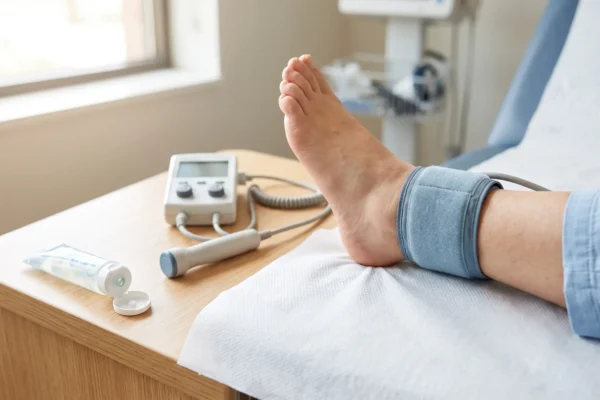
How Is PAD Tested? The Ankle-Brachial Index
It is also used as a screen for people who have risk factors but no symptoms, which matters given how many people fall into that group. If the result is abnormal, vascular ultrasound, a CT angiogram or an MRA usually follow to show where the narrowing is.
What Treatment Usually Involves
Supervised walking programs surprise people, because the instruction to walk through the discomfort sounds wrong. It is a standard part of treatment for claudication, and it is prescribed and monitored rather than something to improvise on your own.
Getting the Bloodwork Done Without the Trip
Results are also a reasonable thing to go through by video rather than in person. Our piece on seeing a specialist by telemedicine sets out what a video appointment handles well, which includes reviewing numbers, adjusting a plan and deciding what gets tested next.
Which Specialist Handles This?
A podiatrist earns their place early here rather than late. Arkady Kaplansky, DPM covers podiatry and foot and ankle care across Los Angeles County, including home visits, office visits and video appointments, which is the kind of access that makes regular foot checks realistic.
Why the Foot Checks Are Not Optional
If getting out of the house is the obstacle, the first appointment can happen at home. The Doctor2me network lists doctors who visit patients at home, which covers the history, the examination and the test orders in one visit.
Frequently Asked Questions
Can a smartwatch or pulse oximeter detect poor circulation in the legs?
Not reliably. Those devices read a fingertip or wrist, which tells you little about the arteries in the legs. An ankle-brachial index measurement is the straightforward test and takes only minutes in a clinic.
Does walking make PAD worse if it hurts?
Not in the way people assume, and supervised walking programs are a standard part of treatment. The key word is supervised, because the plan is prescribed and monitored rather than something to work out alone.
Should I keep my feet warm with a heating pad or hot water bottle?
Be careful with direct heat, especially if sensation is reduced by diabetes. Loose warm socks and movement are safer than anything that can burn skin you may not feel properly.
Can PAD affect the arms as well as the legs?
It can, though the legs are far more commonly affected. Arm symptoms are less typical and worth describing clearly, since they can point towards different narrowing patterns.
If one ankle-brachial index result is normal, is that the end of it?
Not always. Results can look normal at rest and abnormal after exercise, so if symptoms persist it is reasonable to ask whether an exercise version of the test or an ultrasound is appropriate.
Does erectile dysfunction have anything to do with this?
It can be related, because the same narrowing process affects arteries elsewhere. The AHA lists it among PAD-related symptoms, especially in men with diabetes, so it is worth mentioning rather than leaving out.
Sources Used
Is your leg pain actually PAD? Watch for these warning signs – American Heart Association (2025)
Peripheral artery disease – legs – MedlinePlus (2026)
Peripheral Artery Disease – Cleveland Clinic (2025)
Peripheral artery disease (PAD) Symptoms and causes – Mayo Clinic (2024)
What Are the Symptoms of PAD? – American Heart Association (2026)