This content is for informational purposes only and does not substitute professional medical advice. Always consult a physician for diagnosis and treatment.
Recurring dialysis rides work best when they are booked as one standing schedule rather than trip by trip. That single change removes most of the weekly phone calls.
The arithmetic is unforgiving. MedlinePlus (2026) describes in-center treatment as about three sessions a week, each lasting roughly three to four hours. Over a year that is more than 300 one-way trips, so a service that fails one ride in ten fails roughly thirty times.
Why Do Dialysis Rides Fail So Often?
The same study described sessions cut short because a driver would not wait. Clinic social workers reported spending significant time on hold with transportation companies. That is time not spent on care, and it is one reason families eventually start driving themselves.
Missed treatments are not a scheduling annoyance. The National Kidney Foundation (2026) reports a study in which 27 percent of patients had no private transportation to dialysis, and those patients were more likely to skip scheduled sessions, had poorer overall health, and were more likely to die within a year of the study period.
There is a transplant angle too. Consistent attendance is part of being considered for a kidney transplant, so a pattern of shortened or missed sessions caused by rides can narrow options that have nothing to do with transport.
What Does a Recurring Dialysis Transport Schedule Look Like?
Build the schedule around the chair time rather than the clinic’s opening hours. A pickup that lands you forty minutes early three times a week adds up to two hours a week in a waiting room. A pickup fifteen minutes before chair time, with the driver’s number in your phone, works better.
Agree in writing on what happens when treatment runs long. The return pickup is where most complaints start, because a session that overruns by twenty minutes can push a rider past the driver’s next job. A standing instruction to call rather than leave solves most of it.
Ask who holds the schedule. A dispatcher who sees the whole week can shift one ride without rebuilding the rest, while a broker that treats each trip as a separate request will lose the pattern every time staff change.
Who Pays for Dialysis Transportation?
Medicare
An ambulance and a wheelchair van are different categories of vehicle. That distinction is why a family can be told that the rider qualifies medically and still find that the scheduled van ride they want falls outside the benefit they were reading about. Ask the plan which vehicle types it will pay for before booking anything.
Medi-Cal
The practical point is that wheelchair vans sit in the second category. Non-emergency medical transportation requires a prescription from a licensed provider, so the step that unlocks a van is a conversation with the doctor rather than a call to the ride company.
Which office you call next depends on your coverage type. Managed care members start with their plan’s member services, while fee-for-service members tell their medical provider they need it and complete a transportation request form.
When Families Pay Themselves
Ask for the quote as a weekly number rather than a per-trip one. Three round trips a week is the real unit of cost, and some providers price a standing weekly schedule differently from occasional single trips.
Curb-to-Curb, Door-to-Door, or Door-Through-Door?
Door-to-door adds the walk. The driver accompanies the rider between the building entrance and the vehicle while keeping the vehicle in sight, which matters for anyone using a cane, a walker, or a wheelchair, and for driveways with steps or long drop-off areas.
Door-through-door goes further again. The driver goes inside with the rider and stays until someone takes over, which fits riders living with dementia, anyone recovering from sedation, and anyone who should not be left alone at either end of the trip.
Post-dialysis weakness is the reason this choice matters so much. A rider who manages the walk out in the morning may be unsteady four hours later, so the level that fits the return leg is the level to book for both.
| Service level | Who it usually fits | What to confirm when booking |
|---|---|---|
| Curb-to-curb | Riders who can walk in and out unaided | Where exactly the driver stops, and who secures the mobility device |
| Door-to-door | Cane, walker or wheelchair users; steps or long driveways | Whether the driver walks the return leg too |
| Door-through-door | Memory loss, post-sedation weakness, nobody waiting inside | How long the driver will stay, and who signs the handoff |
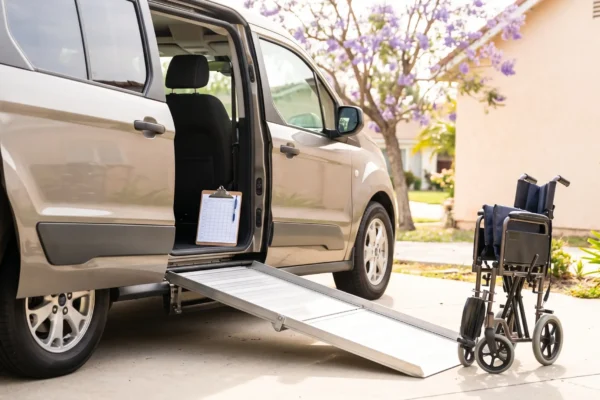
| Wheelchair van (NEMT) | Riders who cannot transfer into a car seat | Whether a prescription is on file, and the ramp or lift weight limit |
The right row is usually decided by the worst moment of the week rather than the average one. Book for the day treatment runs long and the rider comes out tired, and the rest of the week takes care of itself.
Do You Need a Wheelchair Van?
Weight and chair dimensions matter more than people expect. Ramps and lifts have limits, and a heavy power chair can rule out a vehicle that would carry a folding transport chair without trouble. Give the provider the chair model and the rider’s weight when you book rather than on the first morning.
Local coverage is the other practical filter. MediZoom Transportation, LLC runs non-emergency medical transport across Ventura County, including Thousand Oaks, Camarillo, Oxnard, Ventura, Simi Valley, Moorpark, Santa Paula, and Fillmore, which is the kind of coverage map worth checking against the clinic address and the home address together.
What Happens When a Ride Is Late or Never Comes?
Keep a simple log for a month. Date, scheduled pickup, actual pickup, and what happened is enough, and it turns a frustrating conversation into a page of evidence. Clinic social workers can act on a log far more easily than on a complaint.
Have a fallback arranged before you need one. A neighbor, a family member on a rota, or a second provider on file means a no-show costs an hour rather than a whole session. Caregivers who carry the whole fallback alone burn out, which is why respite care in Thousand Oaks comes up in these conversations more often than you might think.
If rides keep failing, ask the clinic about chair times on a different day or at a different hour. Early morning and late afternoon slots have very different transport demand, and a schedule change sometimes fixes what a complaint cannot.
What to Ask Before You Book a Recurring Ride
- Will you hold the same days and times as a standing schedule, in writing?
- What is the return policy when treatment runs long, and will the driver call or leave?
- Which service level is included at this price, and does it apply to both legs of the trip?
- What is the backup when the assigned driver calls out that morning?
- Do you carry wheelchair vans, and what are the ramp and weight limits?
- Is my address inside the covered area, and is the clinic address too?
Ask the last question about both ends of the route. Coverage areas are drawn by zip code and can stop a few streets from a clinic, and a provider who covers the home but not the destination is no use three times a week.
Which plan you hold changes who you ask. HMO vs PPO explains how plan type steers which local providers you can use, and transport benefits follow the same logic as specialist access.
Keeping the Medical Side Steady Too
Some of that care can come to the house. Directories of doctors who see patients at home are worth checking alongside the transport search, because a routine review done in the living room removes a round trip from the week.
Watch the circulation side as well. Leg cramps, cold feet, and slow-healing sores matter in anyone with kidney disease, and cold feet and leg cramps explain the signs that are worth raising at the next appointment rather than at the next crisis.
Kidney disease is also far more widespread than the dialysis population suggests. The CDC (2026) estimates that 14 percent of US adults, about 37 million people, have chronic kidney disease, and about 87 percent of adults aged 20 and over who have it do not know. Families arranging rides today are often the first in the household to learn how the system works.
For households already managing a serious chronic illness alongside dialysis, coordination is its own task. Palliative care for heart failure in the Conejo Valley covers how that kind of support works locally and what it adds to an existing care plan.
Frequently Asked Questions
Can a family member be reimbursed for driving someone to dialysis?
Some plans allow mileage reimbursement for a friend or relative who drives, and some do not. Ask member services specifically about mileage rather than about transportation, because the two sit in different parts of most benefit documents.
How far in advance should a recurring schedule be set up?
Give the provider at least a week, and longer if a wheelchair van is involved, since vehicles with ramps are a smaller part of most fleets. If dialysis is starting soon, tell the clinic on day one so the referral and the ride can be arranged together.
Can a caregiver ride along in the vehicle?
Usually yes, and often at no extra charge, but it needs to be on the booking rather than announced at the door. Seat space in a wheelchair van is limited, and an unexpected passenger can mean leaving someone behind.
What should the rider bring for a four-hour session?
A warm layer, water for after treatment, a phone charger, and the driver’s direct number. Clinics run cold, sessions can overrun, and a dead phone is the single most common reason a return pickup goes wrong.
Does the clinic arrange transport, or is that on the family?
It varies by clinic, and most will help rather than arrange. Social workers usually know which local providers are reliable and can push a plan for approval, so ask at the first appointment who handles transport and what they can do.
What if the rider moves to home dialysis later?
The transport need drops sharply, though training visits and clinic follow-ups continue. Tell the provider before you cancel a standing schedule, since some keep a slot open for a transition period rather than closing the file.
Sources Used
Dialysis – hemodialysis – MedlinePlus, US National Library of Medicine (2026)
Medicare Coverage of Ambulance Services – Centers for Medicare & Medicaid Services, Product No. 11021 (2025)
Study Sheds Light on Transportation Barriers in Dialysis and Why Patient Voices Matter – National Kidney Foundation (2026)
Non-Emergency Medical Transportation – CMS (2025)