This content is for informational purposes only and does not substitute professional medical advice. Always consult a physician for diagnosis and treatment.
Dupuytren’s contracture is a hand condition that causes a slow curling of fingers toward the palm. Tough tissue under the skin of the palm thickens into firm cords that pull one or more fingers down, so they can no longer straighten all the way. It is usually painless, gets worse over years, and most often affects the ring finger and little finger.
If you have noticed your curling fingers making everyday tasks harder, you do not have to sit in a crowded clinic to get answers. With Doctor2me, a licensed doctor can come to your home, look at your hand in a calm setting, and guide your next step. You can also choose your own doctor through the Doctor2me provider network.
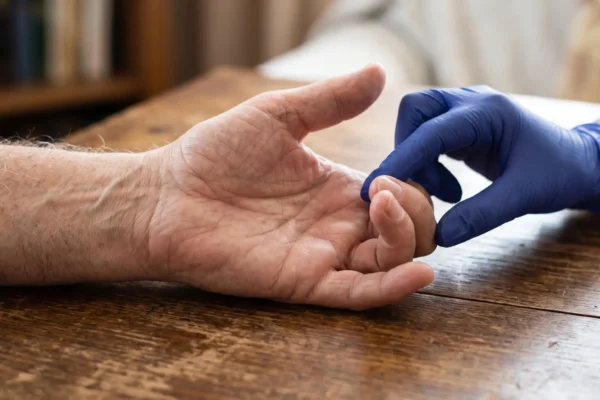
What Is Dupuytren's Contracture?
The first sign is often a small, firm lump in the palm. This lump is usually painless, but the skin around it may look puckered or dimpled. As the disease moves forward, the lump can stretch into a cord that pulls a finger into a bent position.
Dupuytren's Cords and Nodules
Common Dupuytren's Symptoms
- A small lump or nodule in the palm that slowly thickens into a cord.
- Skin on the palm that looks puckered or dimpled.
- A finger that slowly bends toward the palm and will not fully straighten.
- Trouble with daily tasks like shaking hands, putting on gloves, or reaching into a pocket.
Most people feel no pain, but some notice itching, pressure, tension, or a burning feeling. The condition is usually painless yet progressive, which means it tends to move forward with time even when it does not hurt.
The Tabletop Test
What Causes Dupuytren's Contracture?
Genetics and Risk Factors
- Age, since it most often appears after 50.
- Sex, because men are much more likely to develop it than women, and their symptoms may progress faster.
- Diabetes, tobacco use, and heavy alcohol use.
- Jobs that use vibrating tools, which some studies link to the condition.
How Doctors Diagnose It
Because the exam is simple and hands-on, it is a good fit for a home visit. A doctor can watch how far your fingers straighten, run the tabletop test with you, and explain how far the condition has moved along, all without a trip to a busy office.
Treatment: From Simple Steps to New Options
Home Remedies and Everyday Aids
Everyday aids make a real difference when grip becomes hard. A durable medical equipment provider like Medlife Medical Supply, which serves Los Angeles County, Santa Clarita, and Ventura County, can supply padded grips, adaptive tools, and other equipment that make daily tasks easier while you decide on next steps.
Medicine and In-Office Procedures
A procedure called needle aponeurotomy, or needling, uses a thin needle to break apart the cord through numbed skin. It has no large cuts, can treat several fingers at once, and can be repeated if the cord comes back.
Newer Approaches and Surgery
How the Condition Progresses Over Time
Watching your hand at home helps you stay ahead of it. Check your palm now and then for new lumps or dimpled skin. Repeat the tabletop test every few months. If your fingers stop lying flat, or if the curling of fingers toward the palm makes daily tasks hard, it is time to talk with a doctor.
If a flare makes it hard to walk or drive, you do not have to leave home to get help. A Doctor2me doctor can come to you the same day, examine the knee in comfort, and get you started on relief without a stressful clinic visit.
Living With Dupuytren's Contracture
Gentle daily stretches can help keep your fingers as mobile as possible. Warm your hands in warm water first, then slowly straighten your fingers without forcing them. These steps do not cure the disease, but they can make your hands feel more comfortable and keep them working well for longer.
When to See a Doctor
A home visit is an easy way to start. It saves you a trip, lowers stress, and cuts your risk of picking up an infection in a waiting room. You can browse the Doctor2me network to choose a doctor and book a same-day visit, then get clear guidance on whether watchful waiting or treatment is right for you.
Frequently Asked Questions
What is the cause of Dupuytren’s contracture?
The exact cause is unknown, but genes play a big role, so it often runs in families. It is not caused by a single injury. Age over 50, being male, Northern European ancestry, diabetes, smoking, and heavy alcohol use all raise the risk.
How do you treat Dupuytren’s contracture?
Mild cases may only need watchful waiting, padded tools, and gentle stretching. When fingers bend more, doctors use steroid or collagenase enzyme injections, needle aponeurotomy, or surgery to release the cords. No treatment is a permanent cure, so the condition can return over time.
Can Dupuytren’s contracture go away on its own?
No. Dupuytren’s contracture does not go away on its own, and it tends to slowly get worse over years. Early on it may stay mild for a long time. The tabletop test is a simple way to watch for changes and know when to see a doctor.
What is the new treatment for Dupuytren’s contracture?
Collagenase enzyme injections and needle aponeurotomy are less invasive options that break the cords without open surgery. Radiation therapy is sometimes used very early to slow the disease. Your doctor can explain which approach fits how far your condition has progressed.
Can you reverse Dupuytren’s contracture?
Treatments can straighten the fingers and loosen the cords, but they do not permanently reverse the disease. Cords can grow back, and symptoms return within 10 years after surgery in up to half of cases. Ongoing checkups help catch any return early.
What foods should you avoid if you have Dupuytren’s contracture?
There is no proven diet that treats Dupuytren’s contracture. Since heavy alcohol use and smoking are linked to higher risk, cutting back on both is a sensible step. A balanced diet that helps manage diabetes may also help, since diabetes is a known risk factor.