This content is for informational purposes only and does not substitute professional medical advice. Always consult a physician for diagnosis and treatment.
Palliative care is a specialty focused on relieving symptoms and stress from a serious illness such as heart failure or cancer, and it can begin at any stage, alongside curative or active oncology treatment, not only at the end of life. According to CDC FastStats, heart disease caused 683,491 deaths in the United States in 2024, and nearly 6.7 million U.S. adults are living with heart failure. U.S. life expectancy reached 79.0 years in 2024, the highest on record, which means more older adults are living with multiple chronic conditions and need coordinated, home-based support. For Westlake Village seniors facing both an oncology diagnosis and congestive heart failure, in-home palliative care helps manage breathlessness, fluid retention, fatigue, and anxiety while reducing avoidable trips to the emergency department.
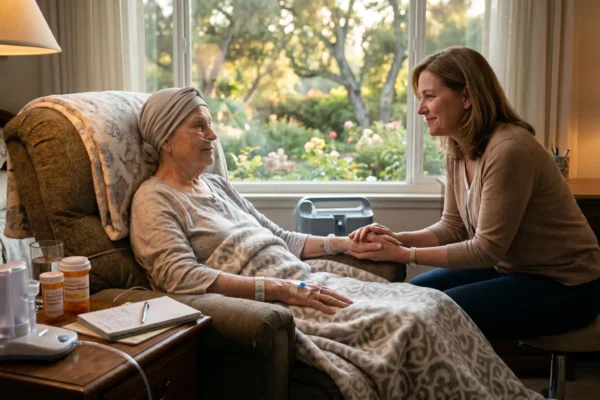
This integrated model addresses the dual challenge of a weakening heart and an active cancer, ensuring families get a plan tailored to their loved one’s situation, goals, and Westlake Village home environment.
Why Is Integrated Care Important for Seniors with Both Heart Failure and Cancer?
Coordinated palliative teams focus on the overlap between the two diseases, which can lower the chance that one condition worsens the symptoms of the other. The American Heart Association’s Scientific Statement on Palliative and End-of-Life Care During Critical Cardiovascular Illness summarizes the evidence that early palliative integration improves symptom control, advance-care-planning completion, and quality of life for seriously ill cardiovascular patients.
| Symptom | Cancer-related cause | Heart failure–related cause |
| Fatigue | Tumor burden, treatment side effects | Low cardiac output and poor oxygenation |
| Pain | Bone or tissue involvement | Chest pressure from fluid congestion |
| Breathing difficulty | Lung involvement or pleural effusion | Pulmonary congestion |
| Reduced mobility | Muscle wasting (cachexia) | Leg swelling (edema), shortness of breath on exertion |
How Do Oncology Treatments Affect Heart Health?
What Are the Early Signs of Cardiac Decline in Cancer Patients?
What Are the Core Strategies of Palliative Care for Heart Failure?
- Respiratory support: non-invasive techniques and positioning to reduce dyspnea.
- Fluid management: daily weight tracking and edema monitoring to prevent painful swelling.
- Emotional support: structured conversations about goals, fears, and care preferences.
- Functional preservation: keeping the patient engaged with routines and family.
How Is Shortness of Breath Managed at Home?
How Is Fluid Retention Managed?
How Does In-Home Care Help?
How Is Palliative Care for End-Stage Heart Failure Different?
| Care component | Early-stage supportive care | End-stage supportive care |
| Primary goal | Manage treatment side effects | Comfort and symptom control |
| Treatment focus | Curative and supportive together | Symptom-driven; aligned with end-of-life wishes |
| Hospitalization | Used for acute stabilization | Often avoided in favor of home-based comfort |
| Team contact | Periodic | Frequent and responsive |
What Comfort Measures Help in Advanced Illness?
- Elevate the head of the bed to ease breathing.
- Keep the room cool and use a small fan to reduce the sensation of breathlessness.
- Apply gentle, unscented lotion to dry or swollen skin.
- Keep lighting soft and the environment quiet.
- Offer small sips of water or ice chips for mouth comfort.
How Does Palliative Care Support the Family?
Is Hospice the Same as Palliative Care?
No. Palliative care can begin at diagnosis and runs alongside active treatment. Hospice is a specific Medicare benefit reserved for patients with a prognosis of six months or less who have chosen comfort-focused care. The Medicare hospice benefit includes four levels of care: routine home visits, continuous care during a symptom crisis, respite care for the family, and general inpatient care when complex symptoms can no longer be managed at home.
When a Westlake Village family reaches that transition, the next step is usually choosing a Medicare-certified local agency. Agencies based on Townsgate Road, such as Westlake Village Hospice, Inc., serve Ventura, Los Angeles, and Orange Counties.
How Can Westlake Village Families Build a Supportive Home Environment?
| Area | What it looks like at home | Why it matters |
| Physical environment | Safety bars, adjustable beds, good lighting | Lowers fall risk; supports better sleep |
| Nutrition | Low-sodium, easy-to-digest meals | Helps with fluid retention; preserves muscle |
| Emotional wellness | Regular visits, counseling, mindfulness | Reduces anxiety |
| Social connection | Video calls, small in-person visits | Reduces isolation |
Where Can Families Find Local Palliative Resources?
How Do Home Safety Modifications Reduce Fall Risk for Heart Failure Patients?
Fall risk rises sharply in advanced heart failure. Edema makes the lower legs heavy and reduces foot sensation, diuretics can cause orthostatic dizziness when standing up, and chemotherapy-related peripheral neuropathy compounds the problem. According to the CDC, more than one in four adults age 65 and older falls each year, and bathrooms are among the most common locations.
Practical modifications that meaningfully reduce risk for a senior with heart failure and active oncology treatment include grab bars in the shower and beside the toilet, a raised toilet seat, a shower bench, non-slip flooring in the bathroom, motion-activated night lights between the bedroom and bathroom, handrails on stairs, and a stair lift when climbing has become unsafe. Most of these can be installed in a day, often without permits.
Local Certified Aging in Place Specialists provide free in-home assessments to map fall hazards before a fall happens. Companies such as Call Before You Fall, based in Agoura Hills, serve Westlake Village, Thousand Oaks, Calabasas, and Simi Valley with stair lifts, bath safety installations, ramps, and handrails.
Conclusion
Frequently Asked Questions
What does palliative care for heart failure involve?
It focuses on relieving symptoms such as breathlessness, fatigue, and fluid buildup. The goal is better daily function and quality of life alongside standard cardiology and oncology treatment.
When should palliative care for end-stage heart failure begin?
The American Heart Association recommends discussing palliative care as soon as symptoms begin to affect daily activities, or after a serious second diagnosis such as cancer. Earlier conversations help prevent avoidable hospitalizations and reduce patient and family anxiety.
Can a senior receive palliative care during active cancer treatment?
Yes. Palliative care is designed to run alongside curative or life-prolonging therapy, especially in patients at risk of cardiotoxicity from chemotherapy.
What is the difference between palliative care and hospice?
Palliative care can start at diagnosis and is offered alongside curative treatment. Hospice is a Medicare benefit for patients with a prognosis of six months or less who have chosen comfort-only care.
How does in-home care help with heart failure?
It reduces the physical strain of traveling to a clinic and limits exposure to infections, which are particularly risky for patients on cancer therapy. In-home physicians can monitor symptoms in the patient’s own environment.
How is fluid retention managed in advanced heart failure?
Through a combination of diuretics prescribed by the cardiology team, sodium restriction, daily weight monitoring, and elevation of the legs as advised. The AHA recommends reporting weight gain of more than 2 to 3 pounds in 24 hours.